
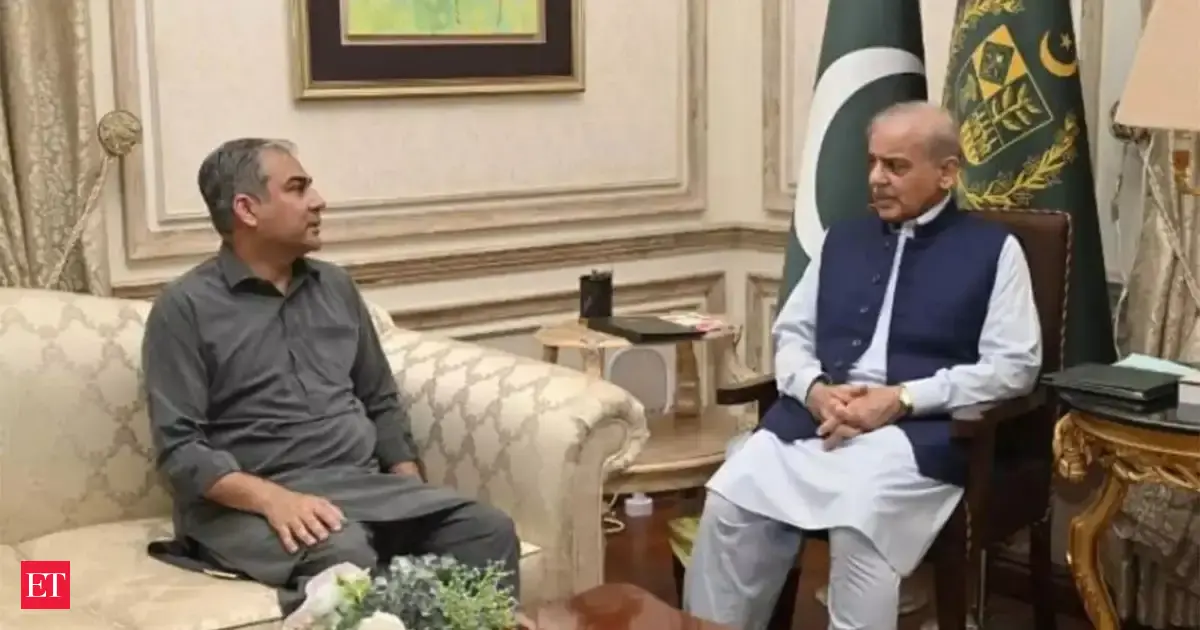
Pakistan Cricket Board (PCB) chairman Mohsin Naqvi will reportedly meet Sharif on Monday and brief him about the former’s meeting with the International Cricket Council (ICC) delegation.
Read also: T20 World Cup match between Pakistan and India: will it happen? Here’s what the PCB and BCB are demanding now and how the ICC has responded
An ICC delegation led by Vice Chairman Imran Khawaja, PCB Chairman Mohsin Naqvi and BCB President Aminul Islam met in Lahore on Sunday to discuss Pakistan’s decision to boycott the 2026 ICC Men’s T20 World Cup match against India scheduled for February 15 in Colombo.
Pakistani media reported that lengthy negotiations have concluded and the dispute is expected to be resolved through mutual consultations in the “next few hours” and a roadmap will be finalized between Imran Khawaja, Mohin Naqvi and Amin ul Islam.

The development came after Pakistani government officials announced that the Men in Green would not take the field in the February 15 clash, and Prime Minister Shehbaz Sharif later linked the boycott to differences with Bangladesh, calling it a symbol of solidarity.
Bangladesh were replaced by Scotland in the 2026 T20 World Cup as their request to play all matches outside India could not be agreed upon by the ICC, which they put in place due to Kolkata Knight Riders (KKR) player Mustafizur Rahman being dropped from the team following instructions from the Board of Control for Cricket in India (BCCI) amid concerns of atrocities against minorities in Bangladesh. Meanwhile, the ICC is understood. ask the PCB to demonstrate what it has done to mitigate the effects of “force majeure” as required by the Member Participation Agreement (MPA). Notably, the ICC received an email from the PCB citing government orders as the reason for the controversial boycott, which took place less than 10 days before the start of the tournament, ESPNCricinfo reported.
In addition, the ICC is understood to have detailed conditions under which “force majeure” can be legitimately invoked, as well as the evidentiary threshold required for non-participation in the tournament, as well as the sporting, commercial and governance implications of such a move.
The ICC has informed the PCB of the potential financial loss that the former may suffer if the match does not take place. The global governing body does not want any confrontation, but according to their constitution they are allowed to suspend/terminate membership in the event of a massive breach of obligations that should have been met.
The PCB also believes that if the issue becomes contentious, they have a strong case as there is a reference to an old dispute between the PCB and the BCCI that reached the ICC Dispute Resolution Committee (DRC) regarding the bilateral series.
The issue was that the BCCI allegedly failed to implement the 2014 Memorandum of Understanding between the two boards and played six bilateral series between 2013 and 2015. The PCB lost its damages claim but believes the Indian government’s refusal to grant BCCI permission to continue the series sets a precedent for them, reports ESPNCricinfo.