
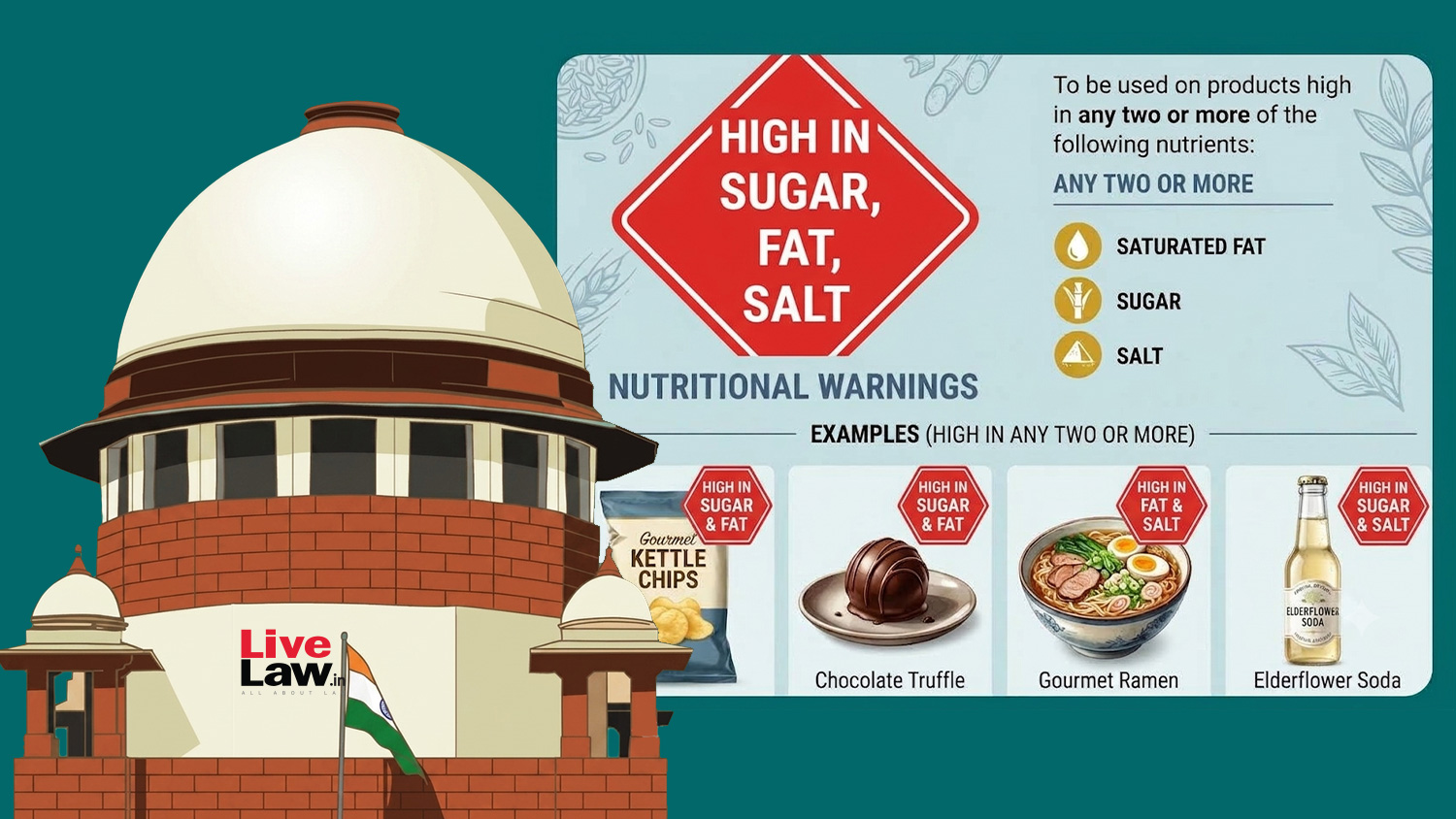
The Food Safety and Standards Authority of India (FSSAI) on Thursday told the Supreme Court that it will consider introducing front-of-pack warning labels for packaged foods high in any one nutrient of concern such as sugar, salt or fat.
FSSAI changed its position after the Supreme Court questioned its earlier proposal to mandate warning labeling only for foods high in two or more nutrients of concern. Responding to the court’s question on why the proposed warning label should be imposed only if the packaged item is high in “two or more” nutrients of concern, FSSAI said it would instead make the warning applicable in one step to products high in at least one nutrient of concern.
The plea came during a public interest hearing on FSSAI’s proposal to introduce red hexagonal warning labels on packaged foods containing high levels of these nutrients.
Bench consisting of Justice J.B. Pardiwala and Justice K. Vinod Chandran listened to this case. The court adjourned further proceedings and indicated that it would pass an order after considering the recent compliance affidavits of the FSSAI and the submissions of the parties.


During the hearing, Justice Pardiwala sought clarification from FSSAI’s counsel on the proposal to introduce warning labels in two stages and whether a product would trigger a warning if it contained only one of the specified nutrients.
Additional Solicitor General Brijender ChaharThe FSSAI lawyer initially explained that a phased implementation would be practical: foods high in two nutrients would trigger alerts in the first phase, while foods high in even one nutrient would be covered in the second phase.
However, the lawyer subsequently clarified that the two-stage implementation was only a proposal and depended on the order of the Court. FSSAI agreed with the Court’s proposal that warning labels should instead be applied in one step, covering foods high in at least one nutrient of concern.
Senior Advocate Maninder Singhspeaking on behalf of the Food Manufacturers Association, expressed concern about the criteria proposed to determine whether a product would carry a warning label. He noted that the proposal includes both a test based on 100 grams of product and a test based on quantity per serving. Singh said the association has made a representation to FSSAI citing ICMR guidelines, which he said prescribes a 100-gram limit while international practice also takes into account serving size.
Senior Advocate Devadatt Kamath presented on the difference between ultra-processed foods and nutritious foods. He argued that the two categories should not be confused, citing turkure and salted cashews as examples. According to Kamath, products like Kurkure should deserve a stricter warning.
Kamath also suggested that the warning label should be displayed in colors other than red, pointing out that the color red is commonly associated with non-vegetarian foods in India.
Lawyer Rajeev Shankar Dwivedispeaking on behalf of the petitioner NGO, also referred to the petitioner’s response and the gaps it pointed out in the FSSAI proposal.
Justice Pardiwala said the court would like to obtain more information from the parties before proceeding with the case.
“We also did some homework. We’ll send the order, maybe upload it tomorrow. Study the order and return with appropriate additional reports.” the court said.
The bench noted that the case will be heard on September 28 after the FSSAI and the plaintiff submit their responses to the order.
“We are concerned about the health of people, especially growing children. We take this very seriously and expect everyone’s cooperation in an endeavor that is in the national interest.” Judge Pardiwala said this while adjourning the case.
Case Details: 3S AND OUR HEALTH SOCIETY v. UNION OF INDIA AND ANR | MA 1177/2025 in WP(C) No. 437/2024