
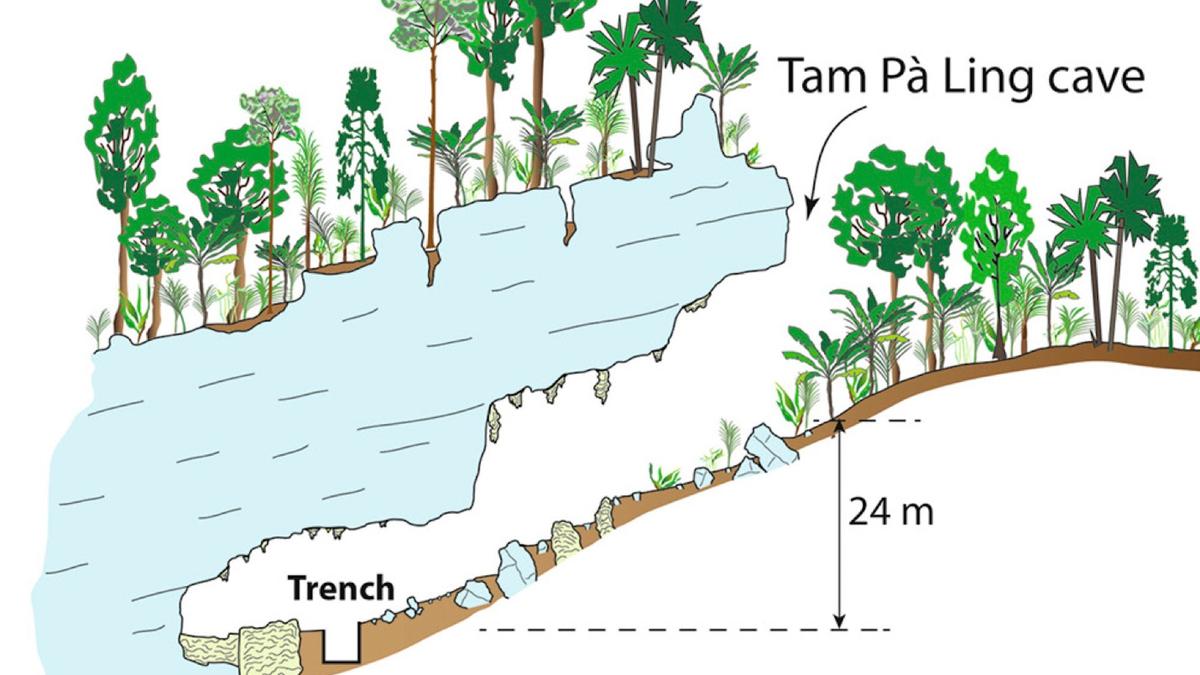
In 2009, when our team first discovered a human skull and jawbone in the Tam Pa Ling cave in northern Laos, some were skeptical about its origins and true age.
When we published a timeline in 2012 for the arrival of modern humans in mainland Asia around 46,000 years ago based on Tam Pa Ling data, skeptics remained.

In short, the site has gotten a bad rap. One of the most interesting caves in mainland Southeast Asia has often been overlooked as a possible route along the generally accepted route of human settlement in the region.
However, a new study published in Natural communicationswe report new human remains found at Tam Pa Ling, as well as a more detailed and reliable timeline of the site. This shows that humans arrived in the region at least 68,000 years ago, and possibly as far back as 86,000 years ago.
Plenty of evidence, but difficult to date.
Our team of researchers from Laos, France, the USA and Australia has been excavating Tam Pa Ling for many years. As we dug, we found more and more evidence Homo sapiens in earlier and earlier times.
First there was a finger bone, then about 2.5 meters deeper, a chin bone, then part of a rib. A total of eight fragments were found in just 4.5 meters of sediment – which may not seem like much, but from an archaeological point of view it is a huge number.
Surely, we thought, this would be enough for Tam Pa Ling to take its place among the sites of early human arrival in Southeast Asia.
But an obstacle remained: the cave was difficult to date. This has prevented recognition of its significance, and without a convincing timeline, evidence from the cave will not be included in the debate about early human movements.
Many common dating methods cannot be used.
There are some difficulties with dating Tam Pa Ling.
Firstly, the human fossils cannot be accurately dated because the site is a World Heritage Site and the fossils are protected under Laotian law.
Secondly, there are very few animal bones and no suitable cave decorations that could be used for dating.
And thirdly, the entrance to the site is wide and steep. This means that any charcoal found in the cave that is useful for dating may well have come from outside, so it has little to do with the age of the sediments inside.
This means that the basis of the time scale must be established by dating the sediments themselves using techniques such as luminescence dating.
Signals in buried minerals
Luminescence dating is based on a light-sensitive signal that accumulates in buried sediments and resets to zero when it is exposed to light.
This method mainly uses two minerals: quartz and feldspar.
Quartz can only be used at lower levels as it is limited by the amount of signal it can hold. In deeper layers, ages can often be underestimated, so at Tam Pa Ling we only used quartz to date the top three meters of sediment.
For the lower levels (four to seven metres) we had to move to feldspar dating to fill the gap in the age profile. Below six meters the feldspar grains began to weather and we had to resort to fine-grain dating using tiny mineral grains mixed together.
Getting to know your teeth
There Pa Ling is relatively poor in animal data. However, two cow teeth were eventually discovered at a depth of 6.5 meters, which could be dated using two different methods.
Dating of uranium series is based on measuring the content of uranium and the elements it turns into through radioactive decay inside the tooth. Electron spin resonance dating is based on measuring the number of electrons in tooth enamel.

Each method offers an individual numerical age for the fossil. By combining them, we have reliable direct dates that can complement the luminescence chronology.
A Closer Look at the Sediment
To make the dating as accurate as possible, we used every possible method, such as applying uranium series dating to the tip of a stalactite that was buried in sediment.
We also began to back up all our dating evidence with very detailed sediment analysis to assess the origins of the fossils.
Micromorphology is a method of examining sediments under a microscope to determine the integrity of the layers in which fossils are buried.
This is a key component of the new chronology because it helped establish that there was a fairly consistent accumulation of layers of sediment over a long period.
By 2022, we had accumulated a wealth of dating data that could be modeled to determine the exact age of each layer and the fossils buried in them.
A stop on the path of human settlement
Our updated chronology showed that humans have been present in the vicinity of Tam Pa Ling Cave for approximately 56,000 years. It also confirmed that the site did not reflect rapid sediment dumping, but rather contained sediment that had been continuously accumulating for approximately 86,000 years.
The age of the lowest fossil, a leg bone fragment found at a depth of seven meters, suggests that modern humans arrived in the region between 86,000 and 68,000 years ago.
Tam Pa Ling’s testimony pushed back the deadline Homo sapiens arrival in Southeast Asia. This suggests that the mainland, as well as coastal and island areas, may also have been a viable route of dispersal.
There, Pa Ling is just a stone’s throw from Cobra Cave, where we found a tooth about 150,000 years old belonging to a Denisovan, a now extinct relative of humans known only from remains found in Siberia and Tibet. This suggests that the site may be on a previously used hominin dispersal route.
There, Pa Ling continues to uncover pieces of the mystery of man’s ancient journey around the world. Only time will tell how much more he has in stock.
Kira Westaway is an Associate Professor in the School of Life Sciences at Macquarie University. Megan McAllister-Hayward is a Ph.D. Mike W. Morley is an Associate Professor at Flinders University. Renaud Joannes-Boillot is an Associate Professor at Southern Cross University. Vito C. Hernandez is a Ph.D. This article has been republished from Talk.

Published – June 27, 2023 03:51 pm EST.