
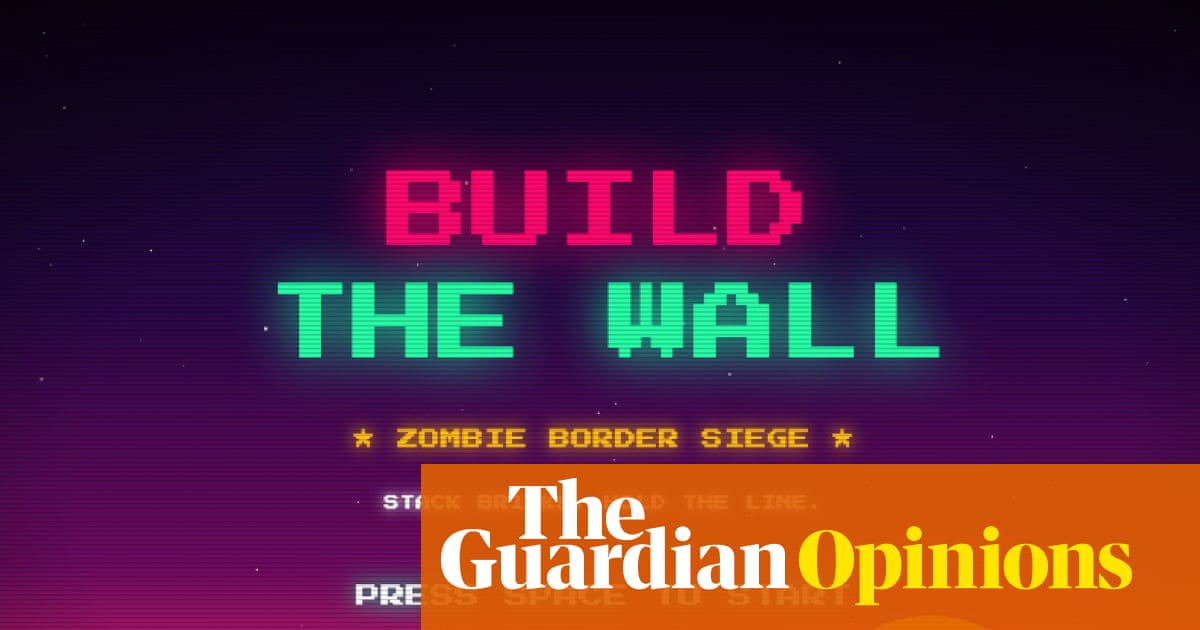
TThe Trump White House on Thursday released a terrible little propaganda arcade game on its website that is a collection of disgusting riffs on popular games. Wrapped in a sweet, nostalgic early ’90s pixel art aesthetic, these mindless fascist diversions seem harmless, but their purpose is sickening: the appropriation of a game in the service of propaganda. This is just the latest in a series of attempts by the Trump administration to use memes and video game images to promote its messages.
After trashing Halo and Pokémon in social media ads last year, telling potential ICE recruits to “stop the flood” and “catch ’em all,” this time the administration has ripped off a series of recognizable games. Flappy Bill, perhaps the least crude version, is a version of the old mobile hit Flappy Bird, only here you are an eagle with a scroll in its talons. Supply Line could almost be an educational game about healthy eating in schools, where you sort junk food from a conveyor belt destined for school lunches, except for some reason you play as a boxer who gets bloodier with every vegetable oil-laden, ultra-processed food item you fail to throw down the trash chute.
Then there are the really nasty ones: Build the Wall, which turns Tetris into a game where you have to fortify the southern border to keep out the “coming horde”, and a little evil version of Snake where you patrol the Rio Grande, collecting brown people who then follow you in orange jumpsuits. The latest game is Trump Savings Tycoon, in which you “fund your kids’ Trump accounts” by netting bills and gold coins. (The Lincoln Memorial’s algae-covered reflecting pool is depicted in the foreground and is inaccurately colored blue.)
I’ve played all of them so you don’t have to. Build the Wall and Rio Run are truly disgusting, built on the blatant dehumanization of migrants, but most of the time these games are simply embarrassing. Like most things coming out of the Trump White House communications team, they are mean-spirited, unimaginative and lazy. I have a strong suspicion that they are coded with artificial intelligence, and I almost hope that they are, because the thought of people wasting their precious time on Earth making these terrible, half-assed games makes me even sadder than playing them.
Anyone who was involved in the creation of the original games that the White House gaming room replicates must be cringing. Members of the original Halo team were forced to speak out on social media after the White House released a photo of Trump as Master Chief last year; I wonder if Sega will say anything about this trailer, which opens with a digital choir singing “Magaaaa” while accompanying the pathetic collection with music that plays many like Sonic’s Green Hill Zone.
The use of video games and their imagery for political influence has been going on for some time, perhaps dating back to Gamergate in 2014, an online harassment movement fueled by Steve Bannon and the far-right website Breitbart. Trump, along with other right-wing regimes, had a huge advantage on this front. “Using the content, culture and aesthetics of video games to communicate is a feature of the Trump White House, not a bug, because much of the modern political right emerged from toxic gaming communities,” says George Osborne, author of The Power Game: Video Games, Politics, and the Battle for Global Influence.
“The activists who formed the Gamergate movement have become a recognized part of the political right… Until now, it seemed limited to social media posts. I estimate that posts with video game codes had about twice the reach of regular White House Instagram posts, suggesting that it may have both irritated audiences offended by its post and delighted supporters. But putting slot machines on its website marks a change of course… Now it looks like the Trump White House is poised to exploit games to start trying to win over audiences—a shift from appropriating video game culture to using the medium itself for our own purposes.”
Artists and activists have long used video games to spread political messages. I’ve played games about escaping a war-torn country; about studying the documents of desperate people on the border of a fictional Eastern Bloc country; about running a dictatorship or overthrowing it. However, governments are new players in this space.
These games, in keeping with the Trump administration’s broader social media and communications strategy, are culture war crap. They are almost completely useless and exist more to irritate us than to convince anyone of anything. If we give them too much resentment, we become drawn into someone else’s game; It’s extremely unlikely that the Rio de Janeiro run will radicalize anyone who isn’t already fully on board with Trump’s whole shtick. But at a time when Saudi Arabia’s wealth fund now co-owns one of the world’s largest game publishers with an investment firm run by Donald Trump’s son-in-law, games’ propaganda potential shouldn’t be a blind spot.